
Best budget air purifiers for small rooms usually come down to three things you can actually feel day to day: whether it moves enough clean air for your square footage, whether replacement filters stay affordable, and whether you can live with the noise on your desk or next to your bed.
If you shop by price tag alone, you can end up with a unit that “runs,” but doesn’t noticeably improve odors, dust, or allergy triggers in a tight bedroom or a small office. On the flip side, you don’t need a premium flagship model to get meaningful air cleaning in a small space.
This guide breaks down what matters for small rooms and offices, how to size a unit without overthinking it, a shortlist-style comparison table, and a practical setup routine so you can get results without wasting money.
What “budget” should still include (and what it shouldn’t)
For small rooms, “budget” works only if the basics are right. A cheap unit with weak airflow can feel like a fancy fan that does very little.
- True HEPA or HEPA-like performance: Many reliable budget picks use a HEPA filter (or equivalent) to capture fine particles like dust and smoke. Marketing terms vary, so check the filter type and replacement availability.
- Enough airflow for your room: Look for CADR (Clean Air Delivery Rate) or a clear recommended room size. CADR is the more honest spec when brands publish it.
- Reasonable filter costs: The “cheap” purifier with expensive filters can cost more by month six.
- Low noise options: A unit that’s too loud gets turned off, and an off purifier cleans nothing.
What you can treat as optional in many small-room cases: Wi‑Fi apps, elaborate sensors, and flashy displays. Nice extras, not always worth paying for.
How to size an air purifier for a small room (without a calculator spiral)
Most people get stuck on sizing, then either overbuy or underbuy. The simple approach is to match the purifier to the room’s real “usage,” not the best-case spec.
Quick sizing rules that work in many homes:
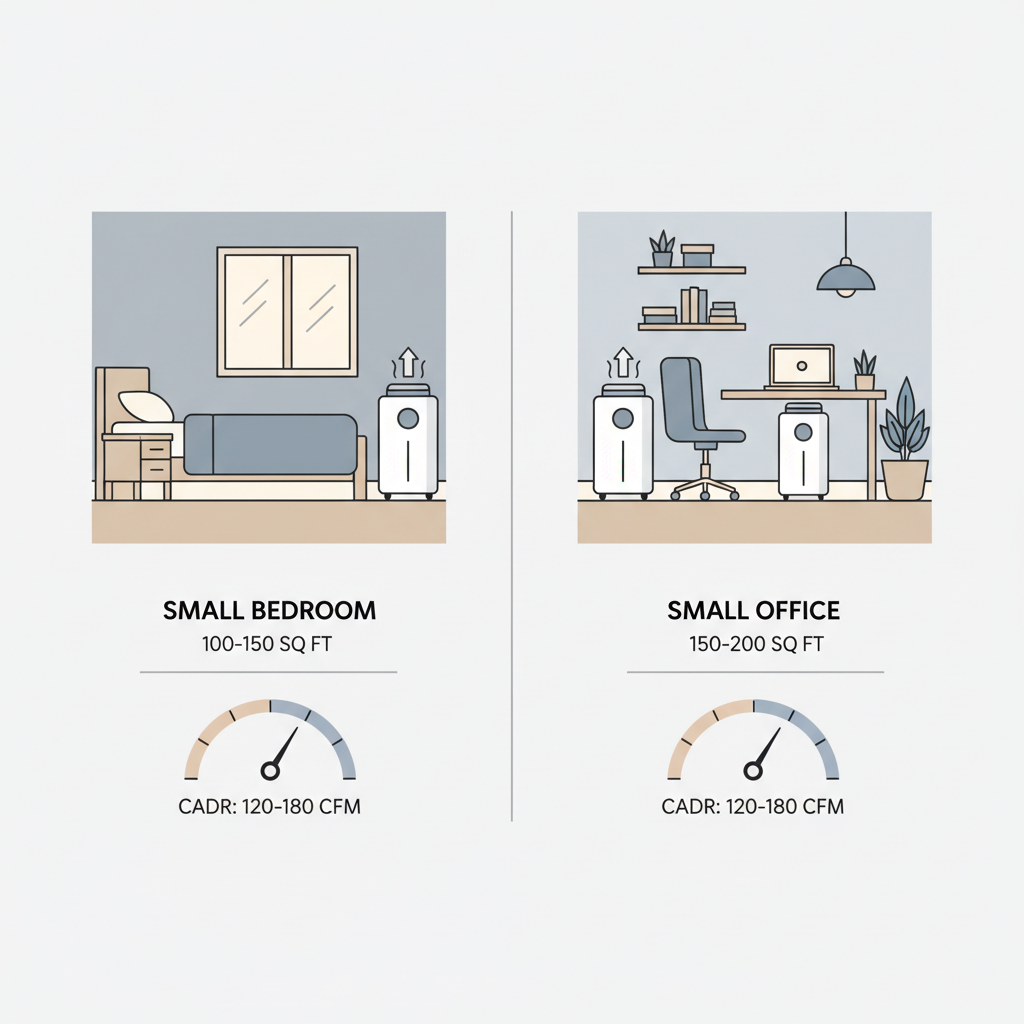
- Bedrooms and small offices (100–250 sq ft): Target a purifier advertised for at least that size, and ideally one step up if you run it on a quiet setting.
- If you want it quiet: Buy a bit more capacity than you “need,” so you can run it on a lower fan speed.
- If you deal with smoke or strong odors: Prioritize higher airflow and a decent carbon layer, not just “HEPA” on the box.
According to EPA (United States Environmental Protection Agency), portable air cleaners can help reduce airborne particles indoors, but they work best as part of an overall strategy, such as reducing indoor pollution sources and improving ventilation when practical.
Comparison table: what to look at when choosing a budget model
Instead of calling out specific products that may change availability or specs, here’s a practical comparison table you can use while shopping. This is usually enough to narrow down to 2–3 solid candidates.
| What you compare | Why it matters in small rooms | Good target for budget picks |
|---|---|---|
| CADR (Dust/Smoke/Pollen) | Predicts how fast it can clean the air | CADR that matches your room size; higher if you’ll run low speed |
| Recommended room size | Marketing can be optimistic | Choose a model rated above your room, especially for quiet use |
| Filter type | Fine particles vs odors are different problems | HEPA (or equivalent) + carbon for smells |
| Filter replacement cost | Long-term cost is where “budget” wins or loses | Easy to buy, reasonably priced, not “rare” brand-only stock |
| Noise (low/high) | Desk/bedside comfort | Low mode that’s sleep-friendly; strong mode for quick cleanups |
| Energy use | Running it longer usually beats running it “hard” briefly | Efficient enough to leave on daily without sticker shock |
| Warranty & returns | Budget models vary in QC | Clear warranty terms and easy returns |
Picking the right budget purifier for your scenario
“Small room” can mean very different things. A nursery, a dorm, and a shared office have different deal-breakers.
For allergies and everyday dust
- Look for HEPA filtration and a solid CADR for pollen/dust.
- Plan to run it most of the day on a quiet setting, not just when symptoms flare.
- If you have pets, expect faster filter loading, which may shorten replacement intervals.
For odors (cooking, pets, “stale room” smell)
- Prioritize a purifier with more activated carbon, not just a token charcoal sheet.
- Be realistic: air purifiers can reduce odors, but eliminating the source (trash, litter box, damp fabric) often matters more.
For wildfire smoke or nearby outdoor pollution
- Focus on high CADR and a well-sealed filter fit.
- Run it continuously during smoky periods, and consider a higher-capacity unit even for a small room so you can keep noise down.
According to CDC, wildfire smoke can affect health, and people with heart or lung conditions may need extra caution; if you have symptoms or a medical condition, it’s smart to ask a healthcare professional what precautions fit your situation.
Self-check: are you buying enough purifier, or just buying cheap?
Use this quick list before you click “buy.” If you hit multiple red flags, pick a different model or size up.
- Your room size is close to the product’s maximum rating and you know you’ll run it on low speed most of the time.
- Replacement filters are hard to find or only sold by one seller with inconsistent stock.
- No CADR and the room-size claim looks exaggerated for the unit’s size and fan power.
- Carbon is vague (“odor reduction technology”) with no mention of activated carbon or amount.
- Noise isn’t specified and you’re placing it next to a bed or on a desk.
Green flags: clearly listed filter model numbers, published CADR, and a return policy that lets you test it in your real room.
Setup steps that make a budget purifier work better
This part is unglamorous, but it’s where a lot of performance gets won or lost.
- Placement: Give it breathing room, usually a couple feet from walls or furniture, and don’t jam it under a desk with boxes.
- Keep doors in mind: If the room door stays open, you’re cleaning a bigger “combined space,” so expect slower results.
- Run strategy: High speed for 15–30 minutes after cleaning, cooking, or bringing in outdoor air, then drop to a quieter setting.
- Filter schedule: Check the filter visually. If it looks loaded early (pets, smoke, construction dust), replace sooner than the box suggests.
- Reduce sources: Vacuum, manage humidity, and address odor sources, your purifier should be backup, not the only plan.
Key takeaway: In many cases, a slightly larger unit run quietly and consistently beats a smaller one blasted on max for short bursts.
Mistakes I see people make with small-room purifiers
- Buying for the “max room size” number then using only low speed because the higher settings are annoying.
- Ignoring filter costs and treating replacements like an afterthought.
- Expecting odor miracles when the source is still present, like mildew, smoke residue, or a litter box next to the unit.
- Running it only when the room “feels bad”, particle levels don’t always match what you can smell or see.
- Putting it in the worst airflow corner, where it recirculates the same small pocket of air.
When to consider professional help (or a different approach)
If you’re seeing persistent symptoms, visible mold, recurring smoke infiltration, or strong chemical smells, an air purifier may help, but it might not be the full answer. In those situations, consider talking with an HVAC professional, an indoor air quality specialist, or a healthcare professional depending on the concern. The right next step can be source control, ventilation improvements, or humidity management rather than simply buying a bigger machine.
Conclusion: the budget sweet spot for small rooms
The best results usually come from a simple combo: choose a right-sized unit with credible airflow specs, keep filter replacements affordable, and run it consistently where you actually spend time. If you do that, best budget air purifiers for small rooms can feel surprisingly close to pricier models in day-to-day comfort.
If you want one action to take today, measure your room, decide whether you care more about quiet or speed, then shortlist two models based on CADR and filter costs. That short list is where smart buying happens.
FAQ
What is the best budget air purifier for a small bedroom?
Look for a compact model with HEPA filtration and a room rating above your bedroom size, especially if you sleep with it on low mode. If the brand lists CADR, that’s a helpful sign you can compare across models.
How do I know if an air purifier is actually helping in a small room?
Many people notice less lingering dust, fewer odors, or easier breathing, but results depend on the source. If your unit has a particle sensor, treat it as a directional clue, not a lab instrument, and focus on consistent use and good placement.
Is a HEPA filter enough for odors in an office?
HEPA is mainly for particles. For odors, you typically want activated carbon as well, and the amount of carbon matters more than fancy wording on the box.
How often should I replace filters in budget air purifiers?
It varies by room conditions, pets, smoke, and how many hours you run it. Follow the manufacturer guidance, then adjust based on visible buildup and performance, and if you have health concerns, consider asking a professional for tailored advice.
Do I need an air purifier if I already have central HVAC?
Sometimes yes, especially for a bedroom or small office where you want targeted cleaning. HVAC filtration helps, but portable units can add extra particle reduction right where you spend time.
Are ionizers safe in small rooms?
Some air cleaners use ionization features that may produce ozone or other byproducts depending on design. If you’re sensitive or unsure, it’s often simpler to choose a model that cleans with mechanical filtration and has clear certifications and documentation.
Why is my purifier loud on high even though it’s “for small rooms”?
High fan speeds move more air, so noise is normal. The workaround is picking a unit with more capacity than your room needs, then running it quieter most of the time.
One last, low-pressure suggestion
If you’re trying to keep costs down long term, build your shortlist around filters first, then the machine. If you’d rather not juggle specs, a simple “small room” kit that clearly lists CADR, filter part numbers, and replacement pricing can save time, especially for bedrooms and home offices.